April Is National Heartworm Awareness Month
By Kelly Harnett
Prevention Is Possible. Responsible Pet Ownership Saves Lives.
Every April, veterinarians and animal welfare organizations across the country come together to raise awareness about one of the most serious — and most preventable — diseases threatening our pets: heartworm disease. At Hobo's Healing Heart, responsible pet ownership is at the core of everything we do. This month, we want to make sure every pet owner in the Black Hills has the information they need to protect their furry family members.
Heartworm is not a distant threat. It is here, in our communities, and it is spreading. The good news? It is entirely preventable.
What Is Heartworm Disease?
Heartworm disease is caused by a parasitic worm called Dirofilaria immitis, transmitted through the bite of an infected mosquito. Once inside a host, the larvae mature into worms that can reach 12 inches in length and take up residence in the heart, lungs, and surrounding blood vessels. Dogs are the primary host, but cats and other mammals can also be infected.
The worms cause severe damage over time — restricting blood flow, causing inflammation, and leading to heart and lung failure. Left untreated, heartworm disease is fatal.
Here's the critical part: by the time a pet shows noticeable symptoms, the disease is often already in advanced stages. Early infection typically produces no visible signs at all.
Heartworm in the Black Hills: What the Data Tells Us
Many pet owners in western South Dakota assume heartworm is primarily a problem in warmer, humid climates — and while those regions do see higher rates, South Dakota is far from immune. The American Heartworm Society's incidence maps have documented consistent heartworm cases across South Dakota year over year, with infection rates rising as mosquito populations adapt to changing weather patterns.
What we know about heartworm risk in our region:
• South Dakota veterinary clinics report positive heartworm tests annually, with numbers trending upward in recent years.
• Mosquitoes — the sole transmitter of heartworm — are active in the Black Hills region from spring through fall, providing ample opportunity for transmission.
• Rescue dogs transported to the Black Hills from higher-incidence states (particularly those in the South and Midwest) arrive having been already exposed, further contributing to local risk.
• Indoor pets are not fully protected — mosquitoes enter homes regularly, and no pet should be considered "low risk" simply because they spend time inside.
• Nationally, more than 1 million pets are estimated to be heartworm-positive at any given time, according to the American Heartworm Society.
What Happens When Prevention Is Neglected?
Heartworm disease progresses through four stages. In the earliest stages, dogs may show mild or no symptoms. As the disease advances, the consequences become increasingly severe and the path to recovery — if recovery is even possible — grows harder and more expensive.
Symptoms of advanced heartworm disease include:
• Persistent cough and exercise intolerance
• Fatigue and weakness
• Swollen abdomen from fluid buildup
• Difficulty breathing
• Cardiovascular collapse and death
Treatment for heartworm, when the disease is caught early enough to treat, is a lengthy, painful, and expensive process. It involves multiple injections of a drug called melarsomine, strict exercise restriction for months (as dying worms can cause fatal clots if dislodged), and careful monitoring. The cost of treatment can range from $1,000 to over $3,500 — compared to the roughly $35–$80 annual cost of preventative medication.
In cats, there is no approved treatment for heartworm at all. Management focuses on supportive care, and the disease can be fatal with little warning.
The suffering is real. The financial burden is real. And virtually all of it is avoidable.
How to Prevent Heartworm
Prevention is simple, affordable, and highly effective. Here's what pet owners should do:
• Talk to your veterinarian. All heartworm prevention requires a veterinary prescription. Your vet will likely recommend an annual heartworm test before starting or continuing prevention, particularly for dogs.
• Use monthly preventatives year-round. Popular options include oral chewables (such as Heartgard or Interceptor) and topical treatments. Some products also protect against fleas, ticks, and intestinal parasites simultaneously.
• Don't skip months. Consistency is key. Even one missed month creates a window for infection.
• Protect cats too. Cats are less commonly infected but can develop serious illness. Topical preventatives are available specifically for feline use.
• Keep records. Save your purchase receipts, pharmacy records, or veterinary invoices showing preventative medication was administered. You may need this documentation.
Hobo's Healing Heart's Policy on Preventable Diseases
At Hobo's Healing Heart, we exist to help pet owners in crisis — to be a lifeline when an unexpected illness or injury threatens a beloved animal companion. We are proud to provide emergency grant funding to families who are doing their very best for their pets.
But our resources are limited, and we have a responsibility to our donors and to the animals we serve. For that reason, Hobo's Healing Heart requires documented proof of preventative care when an application for emergency funding involves a disease that is preventable — including heartworm disease.
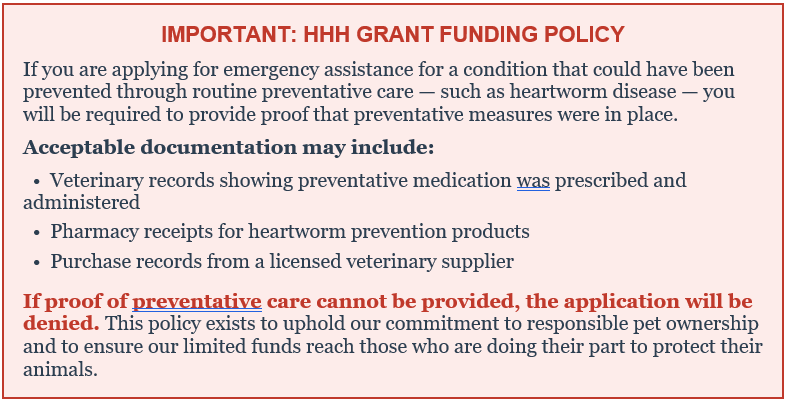
We understand that life gets complicated, and finances are sometimes tight. That is exactly why we exist. But we also know that heartworm prevention is one of the most affordable investments a pet owner can make — and skipping it puts both the animal and the owner in an impossible situation later.
We are here to help in true emergencies. We ask that pet owners meet us halfway by taking the simple, low-cost steps to prevent what can be prevented.
This April, Make the Commitment
National Heartworm Awareness Month is a perfect time to take stock of where your pets stand. If you haven't already, schedule a vet visit, get your pet tested, and start (or continue) a heartworm prevention regimen. Keep your receipts. Keep your records.